ICRISAT and ICAR Announce Release of the World’s First Three-way Pearl Millet Hybrid

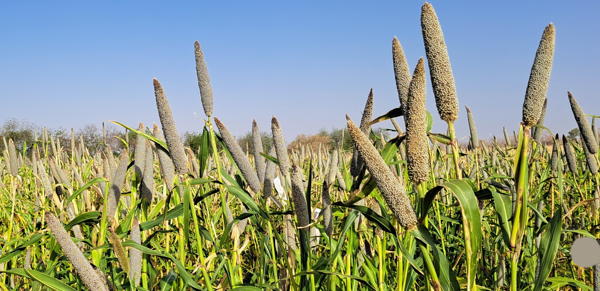
ICRISAT, in collaboration with Indian Council of Agricultural Research (ICAR) through the All India Coordinated Research Project on Pearl Millet (AICRP) centre at the Rajasthan Agricultural Research Institute (RARI) has developed the multifunctional, world’s first three-way pearl millet hybrid, RHB 273.
On 4 January 2026, the Union Minister of Agriculture & Farmers Welfare, Shri Shivraj Singh Chouhan, announced the release of 184 improved crop varieties across 25 crops for cultivation in India. Among these, the ICRISAT-bred pearl millet hybrid RHB 273 has been notified for cultivation in A1 dryland zones, covering parts of Rajasthan, Gujarat and Haryana, characterized by annual rainfall below 400 mm.
Unlike conventional pearl millet hybrids that involve two parents, a three-way hybrid combines three parental lines, enabling the integration of multiple traits such as high yield, drought tolerance, and superior fodder quality.
“Millets are a lifeline for drought-prone regions in Asia and Africa. Pearl millet, in particular, is known for its ability to withstand high temperatures and low water availability,” said Dr Himanshu Pathak, Director General, ICRISAT.
“The ICRISAT–ICAR partnership has delivered several "World's-first" and "India's-first" Pearl Millet varieties. We are pleased to add yet another milestone, "World's First Three-way Pearl Millet Hybrid" in partnership with RARI,” He added.


RHB 273 demonstrated exceptional adaptability and productivity following three years of extensive multi-location testing between 2022–2024 across 30 sites in three states. The hybrid recorded an average grain yield of ~2,230 kg/ha, translating to approximately 13–27% yield advantage over regional varieties.
Notably, it outperformed the widely cultivated HHB 67 Improved by ~28% and shows good resistance to key diseases such as downy mildew, blast, and smut.
Dr Tara Satyavathi, Director, ICAR-Indian Institute of Millets Research (IIMR), Hyderabad, noted, “RHB 273 is an innovative hybrid, and its adoption—especially in the A1 belt will significantly strengthen pearl millet production in drought-prone states of north-western India, contributing to food, nutrition and fodder security.”
Delegates from partner institutions, including Dr P. S. Chauhan, Vice-Chancellor, SKNAU, Jobner; Dr Ummed Singh, Director of Research, SKNAU; and Dr S. K. Jain, In-charge, AICRP on Pearl Millet, RARI; highlighted the hybrid’s potential to address regional food and fodder demand, marking a critical advancement for drought-prone regions.
In the arid and hyper-arid belts of Rajasthan, Gujarat, and Haryana, chronic water scarcity frequently leads to acute shortages of fodder. Beyond strengthening food and nutrition security for vulnerable farming communities, RHB 273 also delivers enhanced fodder availability, helping sustain livestock.

Dr S. K. Gupta, Principal Scientist, Pearl Millet Breeding, ICRISAT, explained, “Three-way hybrids offer better buffering capacity against biotic and abiotic stresses, making them well-suited to stress-prone ecologies. We initiated this novel work in pearl millet in 2019 with our partners, and the results we see today validate the approach.
"This dual-purpose hybrid delivers a integrated solution, from higher farm yields to improved nutrition and better fodder for livestock,” added Dr S. K. Gupta
Through this successful partnership, ICRISAT reaffirms its commitment to science-led collaboration delivering transformative solutions for smallholder farmers across the arid and semi-arid tropics.


This work aligns with SDGs 1, 2, 3 and 17.
For media enquiries, contact:

Parkavi Kumar
Related Articles: